


La gent ha utilitzat canonades des de fa milers d’anys. Potser el primer ús fou per agricultors antics que desviaven l’aigua de les rieres i rius cap als seus camps. Les evidències arqueològiques suggereixen que els xinesos utilitzaven canonada per transportar aigua als llocs desitjats fins a 2000 0010010 nbsp;B.C. & nbsp;Clay tubes that were used by other ancient civilizations have been discovered. During the first century & nbsp;A.D. & nbsp;, the first lead pipes were constructed in Europe. In tropical countries, bamboo tubes were used to transport water. Colonial Americans used wood for a similar purpose. In 1652, the first waterworks was made in Boston using hollow logs.
Development of the modern day welded steel pipe can be traced back to the early 1800s. In 1815, William Murdock invented a coal burning lamp system. To fit the entire city of London with these lights, Murdock joined together the barrels from discarded muskets. He used this continuous pipeline to transport the coal gas. When his lighting system proved successful a greater demand was created for long metal tubes. To produce enough tubes to meet this demand, a variety of inventors set to work on developing new pipe making processes.
An early notable method for producing metal tubes quickly and inexpensively was patented by James Russell in 1824. In his method, tubes were created by joining together opposite edges of a flat iron strip. The metal was first heated until it was malleable. Using a drop hammer, the edges folded together and welded. The pipe was finished by passing it through a groove and rolling mill.
El mètode Russell & # 39; s no es va utilitzar molt de temps perquè al següent any, Comelius Whitehouse va desenvolupar un millor mètode per fabricar tubs metàl·lics. Aquest procés, anomenat procés de soldadura de culata - és la base per als nostres procediments de realització de canonades actuals -. Al seu mètode, s'escalfaven làmines fines de ferro i s'escolaven a través d'una obertura en forma de con -. A mesura que el metall passava per l’obertura, les seves vores s’arrossegaven i creaven forma de canonada. Els dos extrems es van soldar junts per acabar la canonada. La primera planta de fabricació que es va utilitzar
this process in the United States was opened in 1832 in Philadelphia.
Gradually, improvements were made in the Whitehouse method. One of the most important innovations was introduced by John Moon in 1911. He suggested the continuous process method in which a manufacturing plant could produce pipe in an unending stream. He built machinery for this specific purpose and many pipe manufacturing facilities adopted it.
While the welded tube processes were being developed, a need for seamless metal pipes arouse. Seamless pipes are those which do not have a welded seam. They were first made by drilling a hole through the center of a solid cylinder. This method was developed during the late 1800s. These types of pipes were perfect for bicycle frames because they have thin walls, are lightweight but are strong. In 1895, the first plant to produce seamless tubes was built. As bicycle manufacturing gave way to auto manufacturing, seamless tubes were still needed for gasoline and oil lines. This demand was made even greater as larger oil deposits were found.
As early as 1840, ironworkers could already produce seamless tubes. In one method, a hole was drilled through a solid metal, round billet. The billet was then heated and drawn through a series of dies which elongated it to form a pipe. This method was inefficient because it was difficult to drill the hole in the center. This resulted in an uneven pipe with one side being thicker than the other. In 1888, an improved method was awarded a patent. In this process the solid billed was cast around a fireproof brick core. When it was cooled, the brick was removed leaving a hole in the middle. Since then new roller techniques have replaced these methods.
Disseny
Hi ha dos tipus de canonada d’acer, un és perfecte i un altre té una sola costura soldada al llarg de la seva longitud. Totes dues tenen usos diferents. Els tubs transparents solen ser més lleugers i tenen parets més primes. S’utilitzen per a bicicletes i transportar líquids. Els tubs cosits són més pesats i rígids. Tenen una consistència millor i solen ser més estrets. S’utilitzen per a coses com el transport de gas, el conducte elèctric i la fontaneria. Típicament, s’utilitzen en casos en què la canonada no es sotmet a un alt grau d’estrès.
Certain pipe characteristics can be controlled during production. For example, the diameter of the pipe is often modified depending how it will be used. The diameter can range from tiny pipes used to make hypodermic needles, to large pipes used to transport gas throughout a city. The wall thickness of the pipe can also be controlled. Often the type of steel will also have an impact on pipe & #39;s the strength and flexibility. Other controllable characteristics include length, coating material, and end finish.
Matèries primeres
La matèria primera primària en la producció de canonades és l’acer. L’acer està format principalment per ferro. Altres metalls que poden estar presents en l'aliatge són l'alumini, el manganès, el titani, el tungstè, el vanadi i el zirconi. De vegades s'utilitzen alguns materials d'acabat durant la producció. Per exemple, pot ser pintura
s'utilitza si la canonada està recoberta. Normalment, s’aplica una quantitat lleugera d’oli a les canonades d’acer al final de la línia de producció. Això ajuda a protegir la canonada. Tot i que en realitat no és una part del producte acabat, l’àcid sulfúric s’utilitza en un pas de fabricació per netejar la canonada.
La fabricació
Procés
Steel pipes are made by two different processes. The overall production method for both processes involves three steps. First, raw steel is converted into a more workable form. Next, the pipe is formed on a continuous or semicontinuous production line. Finally, the pipe is cut and modified to meet the customer & #39;s needs.
Producció de lingots
1 L’acer fós es produeix mitjançant la fusió del mineral de ferro i del coque (una substància rica en carboni - que es produeix quan s’escalfa el carbó en absència d’aire) en un forn, i després s’elimina la major part del carboni mitjançant la explosió d’oxigen al líquid. L'acer fos es desemboca en motlles de ferro paret gran - gruixuts, on es refreda en lingots.
2 In order to form flat products such as plates and sheets, or long products such as bars and rods, ingots are shaped between large rollers under enormous pressure.
Producció de flors i lloses
3 Per produir una floració, el lingot es passa per un parell de corrons d’acer ranurats que s’apilen. Aquests tipus de corrons es diuen & quot; dos molins alts -. & quot; En alguns casos s’utilitzen tres corrons. Els rodets es munten de manera que coincideixin els seus solcs i es mouen en sentit contrari. Aquesta acció fa que l’acer s’estrengui i s’estengui en peces més fines i més fines. Quan l’operador humà inverteix els rodets, l’acer es tira enrere, fent-lo més prim i llarg. Aquest procés es repeteix fins que l'acer assoleixi la forma desitjada. Durant aquest procés, les màquines anomenades manipuladors llancen l’acer de manera que cada costat es processi uniformement.
4 Ingots may also be rolled into slabs in a process that is similar to the bloom making process. The steel is passed through a pair of stacked rollers which stretch it. However, there are also rollers mounted on the side to control the width of the slabs. When the steel acquires the desired shape, the uneven ends are cut off and the slabs or blooms are cut into shorter pieces.
Tramitació posterior
5 Blooms are typically processed further before they are made into pipes. Blooms are converted into billets by putting them through more rolling devices which make them longer and more narrow. The billets are cut by devices known as flying shears. These are a pair of synchronized shears that race along with the moving billet and cut it. This allows efficient cuts without stopping the manufacturing process. These billets are stacked and will eventually become seamless pipe.
6 Slabs are also reworked. To make them malleable, they are first heated to 2,200° F (1,204° C). This causes an oxide coating to form on the surface of the slab. This coating is broken off with a scale breaker and high pressure water spray. The slabs are then sent through a series of rollers on a hot mill and made into thin narrow strips of steel called skelp. This mill can be as long as a half mile. As the slabs pass through the rollers, they become thinner and longer. In the course of about three minutes a single slab can be converted from a 6 in (15.2 cm) thick piece of steel to a thin steel ribbon that can be a quarter mile long.
7 After stretching, the steel is pickled. This process involves running it through a series of tanks that contain sulfuric acid to clean the metal. To finish, it is rinsed with cold and hot water, dried and then rolled up on large spools and packaged for transport to a pipe making facility.
Fabricació de canonades
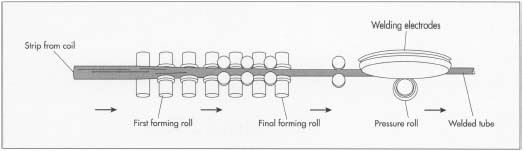
8 Both skelp and billets are used to make pipes. Skelp is made into welded pipe. It is first placed on an unwinding machine. As the spool of steel is unwound, it is heated. The steel is then passed through a series of grooved rollers. As it passes by, the rollers cause the edges of the skelp to curl together. This forms an unwelded pipe.
9 The steel next passes by welding electrodes. These devices seal the two ends of the pipe together. The welded seam is then passed through a high pressure roller which helps create a tight weld. The pipe is then cut to a desired length and stacked for further processing. Welded steel pipe is a continuous process and depending on the size of the pipe, it can be made as fast as 1,100 ft (335.3 m) per minute.
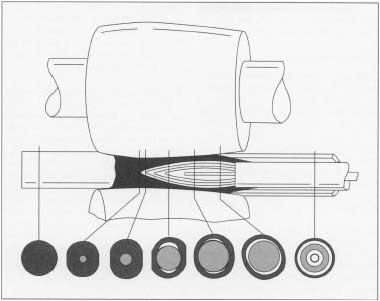
10 Quan calgui una canonada perfecta, s’utilitzen cartells quadrats per a la producció. S’escalfen i es modelen per formar una forma de cilindre, també anomenada rodona. A continuació, es posa un rodó en un forn on s’escalfa de color blanc - calent. A continuació, s'enrotlla amb una gran pressió. Aquest rodatge d’alta pressió fa que s’estengui la billeta i es formi un forat al centre. Com que aquest forat té una forma irregular, un punt de perforació en forma de bala és impulsat per la meitat de la cartellera a mesura que s'està enrotllant. Després de l'etapa de perforació, la canonada encara pot tenir un gruix i forma irregulars. Per corregir-ho es passa per una altra sèrie de molins laminats.
Tramitació final
11 After either type of pipe is made, they may be put through a straightening machine. They may also be fitted with joints so two or more pieces of pipe can be connected. The most common type of joint for pipes with smaller diameters is threading—tight grooves that are cut into the end of the pipe. The pipes are also sent through a measuring machine. This information along with other quality control data is automatically stenciled on the pipe. The pipe is then sprayed with a light coating of protective oil. Most pipe is typically treated to prevent it from rusting. This is done by galvanizing it or giving it a coating of zinc. Depending on the use of the pipe, other paints or coatings may be used.


